

Share
by Zachary Kimball on March 24, 2026
Hardware-as-a-service (HaaS) is gaining momentum across a variety of industries. Many of the early adopters of HaaS are in robotics, offering robots-as-a-service (RaaS) to decrease barriers to entry and improve overall value to customers. Others offer machine-as-a-service (MaaS), device-as-a-service (DaaS), or equipment-as-a-service (EaaS).
Some companies pitch outcomes more than assets, offering data-as-a-service or platform-as-a-service models. From network-as-a-service to facades cleaning; managed service providers (MSPs) to managed security service providers (MSSPs); and autonomous construction equipment to diagnostic sensors and 3D printers, these companies are on the cutting-edge of their fields.
This post is part of a series about modern hardware companies, their business models, and the future of HaaS. For more, see posts from early and late November, early and late December, early and late January, and early and late February.
Coco Robotics
- Founded date: 2020
- Location: Santa Monica, California
- Employees: ~1,000
- What they do: Sidewalk delivery robots for restaurant and grocery last‑mile logistics
- Key customers: DoorDash, Uber Eats, Little Caesars, Jack in the Box, Subway, Goop
- Website: cocodelivery.com
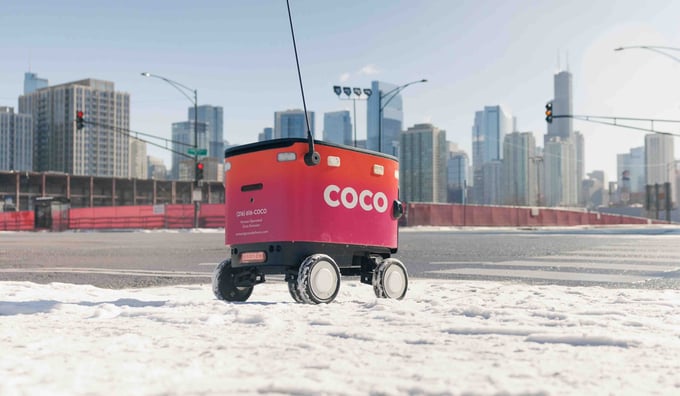
Coco Robotics designs and operates lightweight, battery-powered sidewalk delivery robots engineered for urban environments. Each robot is equipped with a ruggedized chassis, active suspension, and advanced sensor arrays—including cameras and ultrasonic sensors—to safely navigate sidewalks, curbs, and crosswalks. The system runs on Coco’s proprietary autonomy stack, which combines onboard navigation with real-time teleoperations software: while the robots operate autonomously for most routes, they can be seamlessly taken over by remote human pilots when facing complex scenarios like heavy foot traffic or construction zones. Coco’s software also integrates directly with platforms like DoorDash and Uber Eats, enabling intelligent order dispatching, dynamic routing, and fleet coordination—all while eliminating the emissions, costs, and delays of car-based delivery.
The company offers its robots through a hardware-as-a-service (HaaS) model with a usage‑based pricing structure. Merchants are charged per delivery (distance-tiered), with no upfront hardware fees mentioned. For partners like Uber Eats, Coco earns through service agreements, while restaurants piggyback on these integrations for robot delivery. Coco also provides a free trial week to demonstrate ROI and operational impact. The model emphasizes lower delivery cost (up to 50% savings) and improved delivery time (30% faster, 97% on-time). By retaining ownership of the fleet and managing all robot maintenance, operations, and upgrades centrally, Coco allows merchants to adopt robotic delivery without any technical lift or capital expense.
“Coco is proving that autonomous delivery can operate at real scale,” says Zach Rash, co-founder and CEO of Coco Robotics. “With hundreds of thousands of deliveries completed, we’ve built the largest and most advanced robotic delivery fleet in the world. That scale gives us the data, technology, and operational expertise to keep improving autonomy and service quality for our partners. We’ve also designed our model around how service environments actually operate, giving our customers the confidence of fleet ownership, paired with a platform and pricing structure that evolves with their needs.”
Clearpath Robotics
- Founded: 2009 (acquired by Rockwell Automation in 2023)
- Location: Waterloo, Ontario, Canada
- Employees: ~60
- What they do: Autonomous mobile robots (AMRs), indoor/outdoor autonomy software, and R&D robotics platforms
- Key customers: General Electric, Bosch, Microsoft, Intel, Dow, NASA, Carnegie Mellon
- Website: clearpathrobotics.com
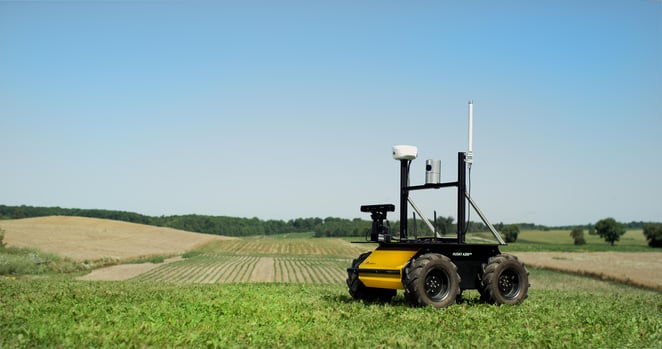
Clearpath Robotics builds open-architecture robotic platforms and autonomy software for advanced mobile robotics. The company’s portfolio includes rugged unmanned ground vehicles (UGVs) like Warthog and Husky, indoor R&D robots like Ridgeback and Dingo, and the Husky Observer: an off-the-shelf outdoor surveillance UGV equipped with 360° vision, thermal imaging, and autonomous patrol capabilities. Each system ships with a Robot Operating System (ROS) pre-installed and is fully extensible with third-party sensors, manipulators, and payloads. For real-world autonomy, Clearpath offers two software platforms: OutdoorNav, designed for GPS-based off-road vehicle autonomy, and IndoorNav, a full-stack indoor navigation system featuring SLAM, dynamic path planning, and obstacle avoidance. Both systems include mission control dashboards, ROS APIs, and web-based tools for live monitoring and customization.
While customers can purchase robot platforms and accessories outright, Clearpath’s autonomy software is offered as a subscription, reflecting a hybrid recurring sales model. Vehicle platforms serve as the hardware foundation, while autonomy capabilities are layered on via software licenses that include updates, support, and extensibility. This model allows R&D teams, OEMs, and industrial developers to iterate quickly without building autonomy infrastructure from scratch, while ensuring scalable fleet coordination, remote operation, and performance monitoring over time. After Clearpath’s acquisition by Rockwell Automation, the model has expanded further: integrated with OTTO Motors and Rockwell’s automation stack, the company now supports enterprise-scale production logistics and autonomous mobility at the factory level.
Humro
- Founded date: 2021 (launched as ARAPL RaaS; rebranded as Humro)
- Location: Morrisville, North Carolina (global HQ in Pune, India)
- Employees: ~50
- What they do: Autonomous warehouse and material‑handling robotics
- Customers: Warehouses and distribution centers across e-commerce, third-party logistics (3PL), retail, and manufacturing
- Website: humro.com
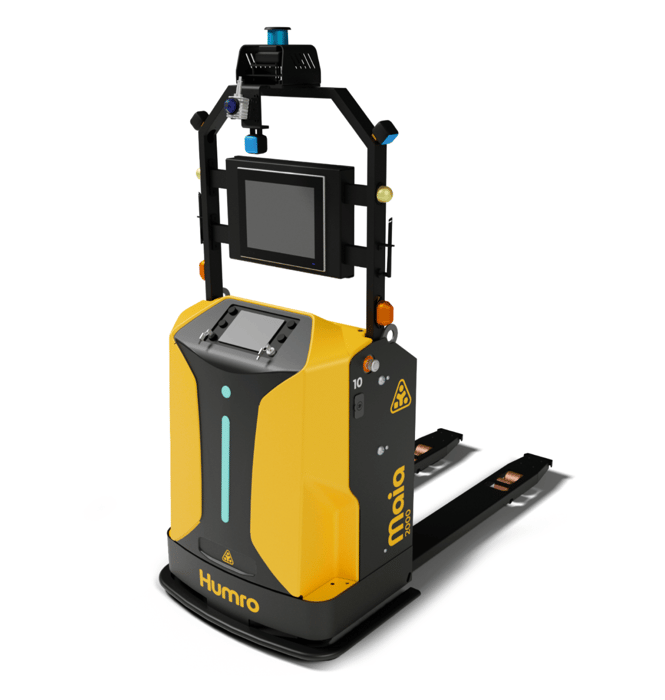
Humro delivers autonomous material handling and warehouse automation through a fleet of intelligent AMRs and autonomous forklifts, paired with a full-stack autonomy and orchestration platform. Its hardware lineup focuses on safety-certified robots and forklifts designed for pallet and load movement in warehouse and manufacturing environments, built to operate safely in mixed human-robot workflows. The robots use LiDAR-based, multi-sensor navigation with real-time obstacle detection and safety-certified control logic, enabling 24/7 operation and human-aware pathing in dynamic facilities. On the software side, Humro’s iWare and FleetOps layers coordinate fleet operations through AI-driven navigation and task execution, while the WCS Extend and WMS layers integrate with existing warehouse systems, conveyors, AS/RS, and third-party automation to support inventory flows, picking, putaway, and cross-docking—all without requiring a full WMS replacement or major warehouse redesign.
Humro operates a flexible hardware‑enabled software model that combines Robotics-as-a-Service (RaaS), leasing, and perpetual license options, allowing customers to adopt automation with low or zero upfront capital. Deployments can be structured around subscription‑style RaaS or leasing arrangements to align costs with usage and operational outcomes over time. Across these models, Humro provides its robots as a managed service—monitoring, maintaining, and managing the autonomous fleet—so customers can scale automation up or down with changing demand while keeping ongoing costs and risk more predictable.
PRENAV
- Founded date: 2013
- Location: Redwood City, California
- Employees: ~15
- What they do: AI-powered drone inspections and 3D digital twins for critical infrastructure
- Key customers: NTT DOCOMO, Senvion, U.S. infrastructure operators
- Website: prenav.com
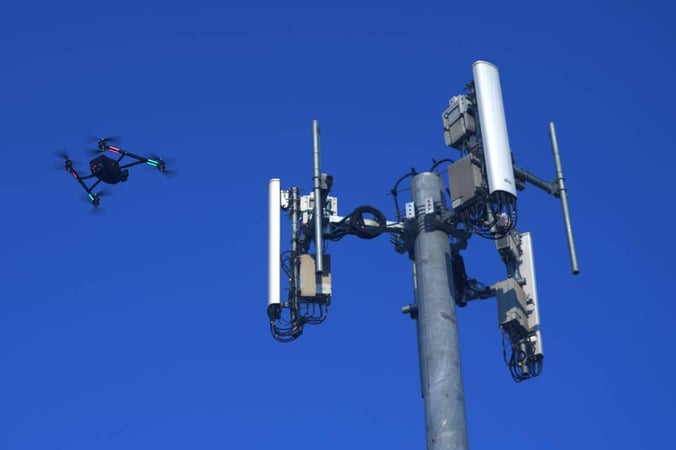
PRENAV provides an integrated drone inspection solution that combines proprietary software with precision guidance hardware to digitize and assess critical infrastructure. The cloud‑based platform, PRENAV.XYZ, transforms drone imagery into detailed 3D digital twins using photogrammetry and other image‑processing techniques, then applies AI and deep learning to detect defects such as cracking in concrete, spalling, exposed rebar, cracks in steel, corrosion, and other surface damage. PRENAV.XYZ is web‑based and can work with imagery captured from drones or other camera and lidar systems, while PRENAV’s own system pairs a drone with a ground‑based guidance robot that first scans the structure, then guides the drone with centimeter‑level accuracy in GPS‑denied or complex environments to capture consistent, repeatable datasets without manual piloting.
The company operates under a SaaS model for its PRENAV.XYZ platform, with clients subscribing to access AI-driven analysis, 3D reconstruction, and cloud-based visualization tools. Hardware is offered as an optional add-on and is currently provided through traditional capital equipment sales rather than a subscription. This hybrid recurring sales model allows customers to start with just the software and expand into full-stack automation as needed, maintaining flexibility while scaling inspection capabilities.
Elementary
- Founded date: 2017
- Location: Pasadena, California
- Employees: ~40
- What they do: AI-powered machine vision inspection systems for manufacturing quality control
- Key customers: Unilever, Yamaha, Toyota, Georgia-Pacific, International Paper
- Website: elementaryml.com
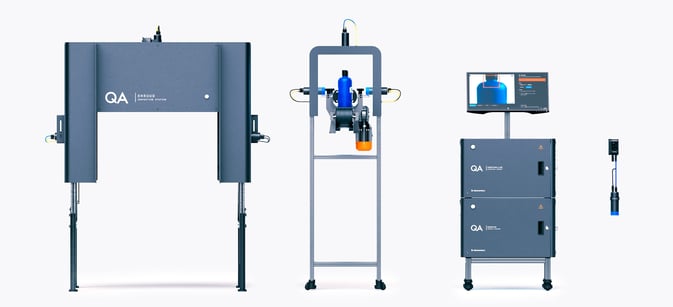
Elementary builds advanced machine vision systems that help manufacturers automate inspection, eliminate quality escapes, and drive measurable ROI in under six months. Its modular platform includes industrial-grade cameras, AI controllers, and a secure, cloud-connected quality operations system that integrates directly with factory PLCs and MES environments. The company supports a wide range of inspections—from label verification and defect detection to sorting, classification, and component presence—across diverse manufacturing sectors.
Elementary’s hybrid business model combines hardware sales (e.g. cameras, lighting, AI controllers) with a SaaS subscription for configuration, training, and continuous learning. Its inspection stations are designed for rapid deployment and ease of use, with no-code tools for non-technical operators and AI models that improve with every inspection. Customers benefit from real-time analytics, remote management, and seamless integration with existing automation systems.