

Share
by Zachary Kimball on July 2, 2025
Subscriptions aren't just for software anymore. From robots to factory sensors to autonomous vehicles, modern hardware companies are rethinking how they deliver value and how they get paid for it. Hardware-as-a-service (HaaS) has become a core model for the equipment industry: physical products bundled with software, support, and predictable revenue.
What is HaaS (hardware-as-a-service)?
Hardware-as-a-service is a business model offered by equipment manufacturers that gives customers access to critical hardware on a subscription or usage-based ("pay per use") payment model. "Pay as you go," "managed services," and "outcome-based asset contracts" are all approaches companies use to build successful hardware-as-a-service offerings.
The model is sometimes known as equipment-as-a-service (EaaS), machine-as-a-service (MaaS), or device-as-a-service (DaaS). In specific industries, it takes the form of robots-as-a-service (RaaS) or 3D-printing-as-a-service (3DaaS), for example.
Bundling proprietary software with proprietary hardware, which then requires proprietary service, is what makes a complete HaaS offering. No buyer has the expertise in-house to maintain complex proprietary equipment on their own, whether an autonomous forklift, an automated tractor, or a metal 3D printer. The HaaS model delivers the right technical expertise as part of an end-to-end solution that has hardware at the center.
HaaS is an evolution from one-time sales of capital goods to a recurring-revenue model. In legacy industry sales terms, it shifts the business model from capital expenses (capex) to operating expenses (opex). Industrial machine manufacturers can implement HaaS with different payment models: time-based (a weekly or monthly term), scale-based (fixed by square footage), utilization-based (per hour of usage), or output-based (per number of tasks an asset performs).
The state of HaaS in 2026
The shift to recurring hardware revenue is no longer an experiment at the edges of the equipment industry. Monitor Deloitte traces the move from capex to opex to three structural drivers: customers now demand the flexibility to pay for output instead of owning the asset; IIoT and AI have matured to the point where equipment can report its own usage and be billed against it; and a long slide in equipment margins has made aftersales the number-one profit driver for many manufacturers.
For customers, one of the strongest arguments for HaaS turns on the cost of failure. Siemens' True Cost of Downtime study estimates that the world's 500 largest companies lose a combined $1.4 trillion a year to unplanned downtime, equal to 11% of their revenue. A HaaS contract ties the provider's revenue to keeping equipment running, which moves the cost of downtime onto the party with the expertise to prevent it. The technology that makes that promise affordable has gone mainstream: the same Siemens study found that nearly half of manufacturers now run dedicated predictive-maintenance teams, double the share in 2019.
For providers, one of the strongest arguments is durability. Recurring revenue holds up through soft years in new-equipment sales, the dip-then-climb pattern Deloitte calls the fish model: revenue falls at the switch to subscriptions, then passes the old level over the life of the contract.
The business case for HaaS: benefits for providers and customers
Hardware-as-a-service offers advantages for both equipment providers and their customers. Here's how both sides benefit.
The benefits of HaaS for equipment providers
Recurring, predictable revenue. HaaS turns one-time sales into ongoing subscriptions, giving providers revenue streams they can forecast. The model offers better visibility into demand and shortens sales cycles: customers face lower upfront costs, so budget approvals happen faster and deals close more quickly.
Higher long-term profitability. Although it takes longer to recoup the cost of goods, HaaS providers typically earn more over an asset's lifetime than they would through a one-time sale. The model lets providers capture more of the equipment's total value while strengthening margins. At Stratasys (below), for example, recurring revenue dominates: in 2025, the consumables its customers reordered brought in $248.7 million, nearly double the $131.6 million the printers themselves sold for.
Stronger customer retention. By bundling hardware with software, maintenance, and services, providers create an integrated, ongoing relationship. Customers rely on the provider for everything from software updates to equipment repairs, and usage-based billing keeps the business model aligned with delivered value.
The benefits of HaaS for customers
Lower upfront costs and predictable pricing. HaaS replaces steep capital expenditures with manageable operating expenses. Flat monthly or annual fees improve budgeting and free up cash flow, while the provider's responsibility for maintenance removes unexpected repair costs.
Built-in scalability. Customers can scale their hardware footprint up or down as business needs shift, without being stuck with idle assets. That flexibility helps companies with seasonal demand or evolving operations.
Always up-to-date, fully maintained equipment. Since the provider retains ownership, they're incentivized to keep hardware in top shape. Customers get proactive maintenance, timely upgrades, and less risk of costly downtime or obsolescence, all without needing in-house technical expertise. Given what a single hour of unplanned downtime now costs, that maintained-uptime guarantee is often the core of the purchase.
3 hardware-as-a-service examples
Manufacturers building a wide range of hardware are turning to managed models: warehouse automation systems, smart radiator controls, electric lawnmowers, drywall finishing robots, industrial 3D printers, temperature and occupancy sensors, and more. These hardware-as-a-service agreements combine different components under different HaaS pricing plans, and they all promise recurring service in exchange for recurring payments.
Dematic
Dematic builds intelligent automation systems for the supply chain, used across manufacturing, e-commerce fulfillment, retail, and food and beverage distribution. Its hardware spans high-density storage systems, automated piece-picking, conveyor and sortation lines, AGVs, and robotic palletizing, and it runs through the Dematic Warehouse Execution System (WES), the software that orchestrates how goods move across a facility.
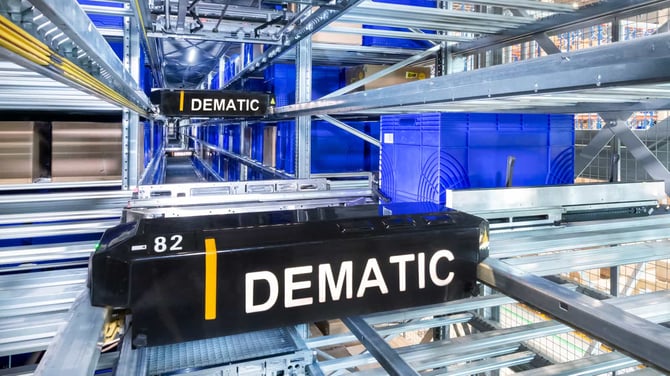
Dematic has traditionally sold its systems as capital equipment. But as supply chains grow more complex and capital budgets tighten, the company has built out managed-services offerings in which customers hand day-to-day system operations to Dematic, layering monitoring, maintenance, and 24/7 support on top of the installed automation to protect uptime and reduce expenses. That managed-services layer is how a capital-equipment maker more than two centuries old begins the shift from capex to opex.
Kelvin
Kelvin helps decarbonize older buildings by combining retrofit-friendly hardware with cloud-based automation. Its flagship product, the Cozy, is a thermostatic cover that turns steam radiators into zone-controlled systems, reducing overheating and energy waste in buildings that lack central HVAC. The company has since expanded into hybrid electrification, integrating heat pumps and thermal storage to shift buildings toward electric heating and cooling with minimal infrastructure upgrades. All systems tie into Kelvin's software layer, which provides remote monitoring, analytics, and building-wide control.
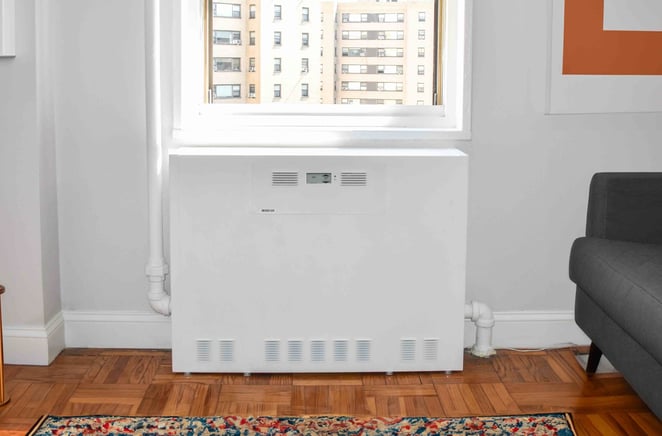
Kelvin operates under a flexible hybrid model. Property owners can purchase the hardware outright or enroll in a no-money-down subscription: a fixed monthly price per apartment that covers hardware, installation, maintenance, dashboard access, and ongoing software, designed so energy savings offset the fee. Larger electrification projects are often financed through energy-as-a-service contracts, and Kelvin works with partners like ClearGen, which has committed up to $100 million to fund these deployments. The structure lets building owners cut energy use and emissions without fronting the capital.
Stratasys
Stratasys makes industrial 3D printing systems for aerospace, automotive, healthcare, and consumer goods manufacturers. Its hardware spans three polymer additive-manufacturing lines, FDM, SAF, and PolyJet, and the printers run on Stratasys's own materials and its GrabCAD software, which prepares print jobs, manages design files, and tracks production across a fleet.
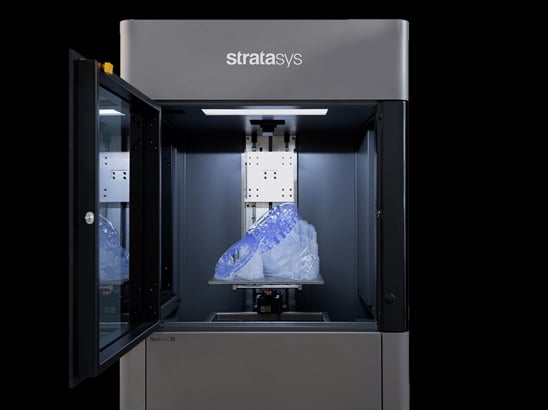
Stratasys runs a hybrid model. The printers sell as capital equipment, bought outright rather than on subscription, and the recurring revenue comes from what the hardware needs to keep running: customers reorder proprietary resins and thermoplastics for the life of each machine and pay ongoing fees for maintenance, support, and software. The one-time sale opens the relationship, and the materials and service contracts are what compound over the years that follow.
What hardware services are provided in HaaS?
There are eight common categories generally included as part of a HaaS solution (including the hardware itself). Every managed hardware company combines some subset of these categories to define its unique offering:
1. Hardware. All HaaS offerings include some piece of hardware. This might be referred to generically (a device, equipment, or machine) or described more specifically (a robot, sensor, or tracker). Hardware is sometimes included as part of a package, sometimes offered separately on recurring payments, and sometimes sold outright as part of a hybrid HaaS offering.
2. Software. Most HaaS offerings include one or more flavors of software: firmware on the equipment, a software package installed on the machine itself, software running on a local server (such as a WMS), or software-as-a-service delivered via the cloud. This component can also include software updates and upgrades.
3. Consumables. Depending on the HaaS program, consumables may be a core offering. Consumables are items used up or worn out in the process of running the HaaS solution. Among the most common examples are print media for printing systems and additive manufacturing (inks, cartridges, resins, and powders). If consumables are regularly needed, they must be considered in the solution design.
4. Accessories. Accessories enable the hardware or extend the HaaS solution with additional capabilities. Accessories are often sold separately from the core equipment, even though an accessory may itself be a piece of equipment (which takes time to reach the end of its useful life) rather than a consumable (which is used up relatively quickly).
5. Installation, setup, and training. For some HaaS solutions, such as deeply integrated systems, installation, setup, and training are a significant investment for the manufacturer. For other standalone products, there is minimal or no work needed up front to configure the deployment.
6. Maintenance, support, and repair. Many HaaS programs require regular upkeep to deliver the full solution on an ongoing basis. This could be ad hoc maintenance if hardware stops running, components that require occasional repair, or software that incorporates manufacturer support. Very few HaaS solutions require no ongoing enablement during the term of the contract.
7. Warranty programs and service plans. Warranty programs and service plans assure the subscriber that the HaaS solution will consistently operate at committed performance levels. These plans are often sold as an add-on to the base plan because they're oriented around risk mitigation. They're most often sold to subscribers trying HaaS for the first time, when the solution runs mission-critical operations, or when the subscriber has a lean in-house team.
8. Delivery and shipping. Depending on the complexity of the HaaS solution, delivery and shipping can be a significant cost. When charged, these fees may be a fixed rate, invoiced as a pass-through from the delivery service, or direct-billed from the freight carrier.
How HaaS compares to other models
While hardware-as-a-service shares some traits with other "as-a-service" and financing models, there are key differences in how value is delivered, how hardware is managed, and who takes on long-term responsibility.
HaaS vs. traditional hardware sales
In traditional hardware sales, manufacturers sell the equipment with no ongoing service, software, or support required. By contrast, HaaS evolves the hardware pricing model with software, installation, monitoring, maintenance, and more. It's a fully managed solution rather than a product.
HaaS customers are buying access to an ecosystem rather than a machine. This shift from ownership to bundled services allows for automation, predictive maintenance, and tighter integrations across workflows.
HaaS vs. leasing
Leasing lets customers make monthly payments toward eventual hardware ownership, with express or implied interest. Maintenance and repairs typically become the customer's responsibility once the lease ends.
With HaaS, customers never own the hardware. The manufacturer retains responsibility for the full equipment lifecycle, including ongoing performance, upgrades, and end-of-life disposal. The focus is on uptime and utility rather than asset ownership, which aligns HaaS with business outcomes and long-term service quality.
HaaS vs. infrastructure-as-a-service (IaaS)
Both HaaS and IaaS are pay-as-you-go models. IaaS gives customers remote access to virtual infrastructure such as servers, compute power, and storage. HaaS provides physical hardware that lives at the customer's site and is managed by the provider.
HaaS introduces operational challenges that IaaS does not, such as shipping, setup, repair programs, and asset tracking. HaaS also involves tighter hardware-software integration and often includes more complex billing logic tied to physical usage.
HaaS vs. platform-as-a-service (PaaS)
PaaS gives software developers access to remote platforms to build, test, and deploy applications, removing the need to maintain infrastructure or environments. PaaS is entirely cloud-based.
HaaS is grounded in physical products. The provider has to manufacture, store, ship, monitor, and maintain physical hardware at the customer's location. That makes billing and accounting much more complicated for HaaS companies than for PaaS companies. HaaS companies must manage a subscription and also track hardware activity in the field and assign that activity to commercial contracts.
Is hardware-as-a-service the right model for your business?
HaaS is the right model for an organization, and for its customers, in several circumstances:
- When it makes economic sense for the buyer not to own a piece of hardware outright (e.g., up-front costs are too high, or seasonality and scaling would leave the hardware dormant for stretches of time)
- When the buyer has to continuously engage the hardware manufacturer, so the primary value proposition is connected as much to the ongoing service as to the hardware itself (e.g., a farm's technicians don't have the skills to maintain an autonomous tractor leased from a HaaS provider)
- When the hardware can be monitored and managed remotely, upgrades and updates can be deployed over the air, and usage and performance data is shared directly back to the manufacturer (e.g., vibration monitoring sensors, in which the value sits in the analytics drawn from the hardware data rather than the sensors themselves)
How should an equipment company decide when HaaS makes sense? How does a business best monetize its hardware to see returns? There's no single right answer, since different assets and verticals carry different customer assumptions, expectations, and pressures. Three things are worth considering:
- Consider the hardware itself. Is your hardware a high-value asset with high-stakes outcomes? A HaaS model stops making sense when the combined cost of hardware-plus-services climbs so high that the buyer is better off purchasing or building their own solution.
- Consider the end-to-end solution. In a HaaS model, customers pay as much for the ongoing service as for the hardware. Manufacturers considering a transition to HaaS need to assess realistically how much value they provide for those ongoing costs to be worth it to customers.
- Consider the company’s resources. Do you have the resources to build the proprietary software that accompanies a managed hardware solution? Is your organization financially prepared to wait, perhaps for a long time, for a return on investment for the hardware you're manufacturing?
As the HaaS business model evolves, technology has to evolve to support it. That's where Hardfin comes in: to help you manage, operate, and report on your hardware business, whatever the complexity of your model. Track every asset, manage financial operations, and turn every piece of hardware into recurring revenue.
Reach out for an intro call. We'd love to hear from you.