

Share
by Zachary Kimball on April 20, 2026
Hardware-as-a-service (HaaS) is gaining momentum across a variety of industries. Many of the early adopters of HaaS are in robotics, offering robots-as-a-service (RaaS) to decrease barriers to entry and improve overall value to customers. Others offer machine-as-a-service (MaaS), device-as-a-service (DaaS), or equipment-as-a-service (EaaS).
Some companies pitch outcomes more than assets, offering data-as-a-service or platform-as-a-service models. From network-as-a-service to facades cleaning; managed service providers (MSPs) to managed security service providers (MSSPs); and autonomous construction equipment to diagnostic sensors and 3D printers, these companies are on the cutting-edge of their fields.
This post is part of a series about modern hardware companies, their business models, and the future of HaaS. For more, see posts from early and late December, early and late January, early and late February, and early and late March.
Dematic
- Founded date: 1819 (as Mechanische Werkstätten Harkort & Co.)
- Location: Atlanta, Georgia
- Employees: ~11,000
- What they do: Supply chain automation and warehouse orchestration
- Key customers: Scentsy, Coca-Cola, Adidas, L’Oréal, Woolworths, Coles, Toyota
- Website: dematic.com
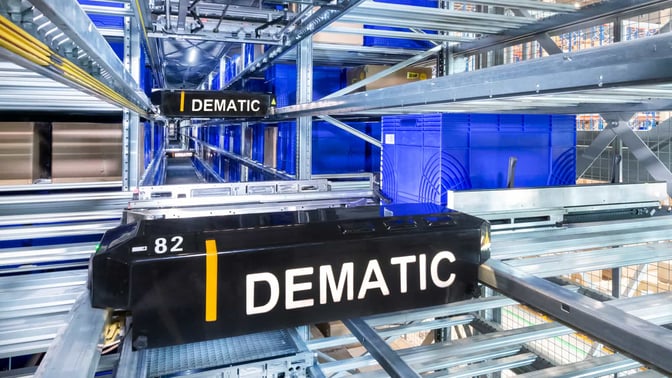
Dematic builds intelligent automation systems that power the modern supply chain, from manufacturing and e-commerce fulfillment to retail and food & beverage distribution. The company’s solutions include high-density storage systems (like AutoStore), automated piece-picking, conveyor and sortation technology, AGVs, robotic palletizing, and the Dematic Warehouse Execution System (WES). With a footprint spanning more than 35 countries and 11,000 employees, Dematic delivers everything from single-point automation to fully integrated warehouse ecosystems. Its customers benefit from increased speed, accuracy, and efficiency.
Dematic has traditionally operated on a capital expenditure (CapEx) basis. But as supply chains grow more complex and capital budgets tighten, the company is increasingly offering its technologies through managed services and Hardware-as-a-Service (HaaS) arrangements. These models bundle hardware, software, maintenance, and remote monitoring into predictable, subscription-style contracts, reducing upfront investment while ensuring uptime, scalability, and ongoing innovation. Through partnerships with NVIDIA and Accenture, Dematic is also developing AI-powered digital twins and orchestration platforms that enable real-time system optimization and scenario planning, pointing to a future in which automation is continuously improved, not just installed once.
“The most important thing we offer customers with our service is peace of mind,” says Alberto Rostagno, SVP of Commercial & Sales at the company. “When companies choose a Dematic solution, they can fully concentrate on their core business while we take care of the optimal performance of the automated system. Maximum availability, performance and cost control—these three elements form the basis for a strong service performance”
Contoro Robotics
- Founded date: 2022
- Location: Austin, Texas
- Employees: ~40
- What they do: Robotic unloading for trailers and shipping containers
- Key partners: PetSmart, NASA, The University of Texas at Austin, Harmonic Bionics
- Website: contoro.com
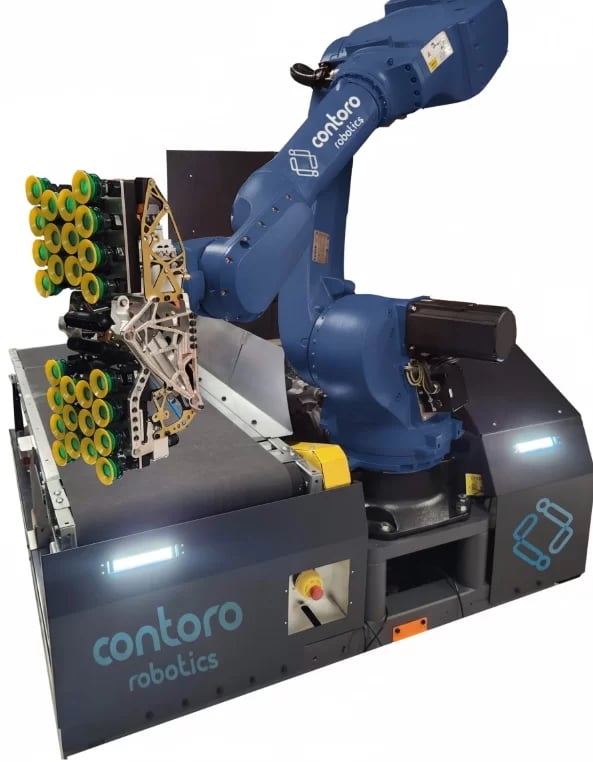
Contoro Robotics builds AI-powered robotic systems for unloading floor-loaded trailers and shipping containers. Designed to address one of the most labor-intensive and hazardous logistics tasks, Contoro’s robots combine advanced perception, motion planning, and patented gripper design with a unique human-in-the-loop (HITL) architecture. The company’s system integrates AdaptAI, which simulates real-world environments to plan optimal movements, and InteleOp, which enables remote human teleoperation in complex edge cases. This approach ensures reliability from day one, with the robot achieving over 99% accuracy in challenging warehouse environments, even where traditional automation fails.
Contoro’s pricing follows a pay-per-container model—a flexible, usage-based Robotics-as-a-Service (RaaS) approach. Customers avoid heavy upfront capital expenditures and instead pay for robot services based on volume, making automation predictable and affordable. The subscription includes the hardware, AI software, remote operations support, and continuous software improvements. This model gives facilities a way to scale robot capacity with demand, ensuring efficiency without financial risk. The offering is especially attractive to logistics and e-commerce operations that face variable throughput and tight margins.
PAL Robotics
- Founded date: 2004
- Location: Barcelona, Spain
- Employees: ~150
- What they do: Humanoid and service robotics platforms
- Customers: Research institutions, healthcare facilities, industrial automation teams, and retail operators across 35+ countries
- Website: pal-robotics.com
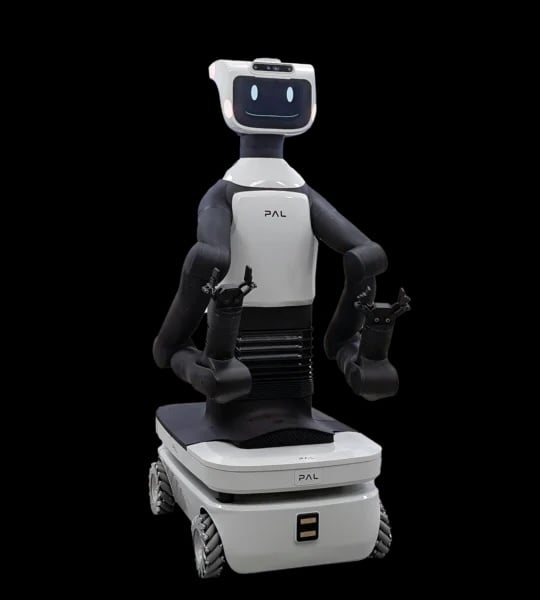
PAL Robotics designs and manufactures a broad portfolio of advanced service robots, including bipedal humanoids, mobile manipulators, and autonomous navigation platforms. Their flagship mobile manipulator, TIAGo Pro, features joint-level torque control, state-of-the-art HRI capabilities, and an upgraded electronics architecture for high-performance computation. PAL’s humanoid lineup includes TALOS, a fully torque-controlled bipedal robot for advanced R&D and industrial support, and ARI, a socially interactive robot combining AI, mobility, and expressive design for customer engagement and human-robot interaction. Every platform runs on ROS, is modular and customizable, and is backed by PAL’s engineering services, simulation tools, and real-time analytics. From autonomous shelf-scanning in retail to assistive functions in healthcare, PAL’s systems are built to integrate seamlessly into real-world operations and collaborative research initiatives.
To make its robotics ecosystem more accessible, PAL offers a flexible hardware + software subscription model with multiple deployment options: full robots-as-a-service (RaaS) agreements, modular rentals, and long-term research and development partnerships. These programs include hardware leasing, ongoing ROS-based software support, engineering assistance, and firmware updates, tailored to the needs of academic labs, pilot deployments, or production environments. Whether it's scaling TIAGo Pro across an industrial robotics testbed or deploying StockBot for autonomous inventory checks, customers can engage with PAL’s technology without the burden of full capital investment. By layering in services such as training, customization, and remote diagnostics, PAL ensures that every subscription supports long-term innovation and hands-on collaboration.
Butlr
- Founded date: 2019
- Location: Burlingame, California
- Employees: ~90
- What they do: Wireless thermal occupancy sensors for spatial intelligence in buildings
- Key customers: Verizon, Microsoft, Netflix, Qualcomm, Walmart
- Website: butlr.com
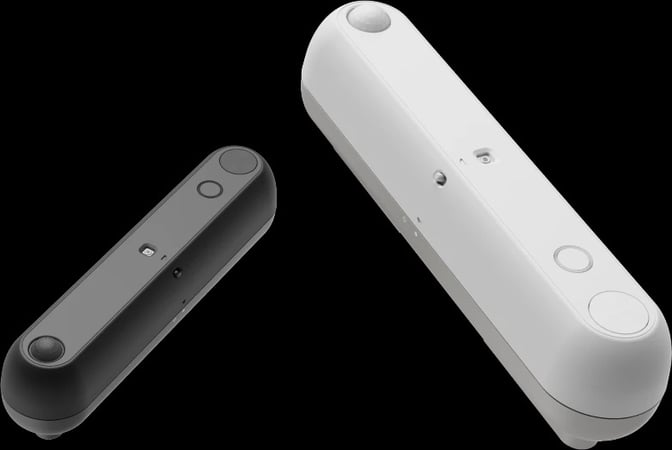
Butlr provides an integrated hardware–software platform for spatial intelligence in smart buildings. The Heatic sensor is a battery-powered, wireless thermal array that anonymously detects human presence, movement, and occupancy without cameras or PII capture. Installed in minutes, these sensors stream data to a cloud platform offering real-time insights on traffic flow, occupancy trends, and fall detection, with SOC 2 Type II security and encrypted transmission. The system supports use cases across workplaces, retail, senior care, and smart buildings, enabling energy optimization, space planning, and safety alerts.
The company operates on a hybrid hardware + software subscription model. Customers purchase or license the Heatic sensors and gateways upfront, then pay an ongoing SaaS fee for access to the cloud analytics platform, alert services, API integration, and support. This recurring model ensures continuous feature updates, remote management, and data-driven insights, while aligning with customers’ goals of space efficiency, privacy compliance, and automation accessibility.
Robomart
- Founded date: 2018
- Location: Glendale, California
- Employees: ~15
- What they do: On-demand, self-driving “store-on-wheels” platforms for grocery, pharmacy, and snack delivery
- Key customers: The Medicine Shoppe, REEF, Unilever (Ben & Jerry’s), partnerships with Uber Eats
- Website: robomart.ai
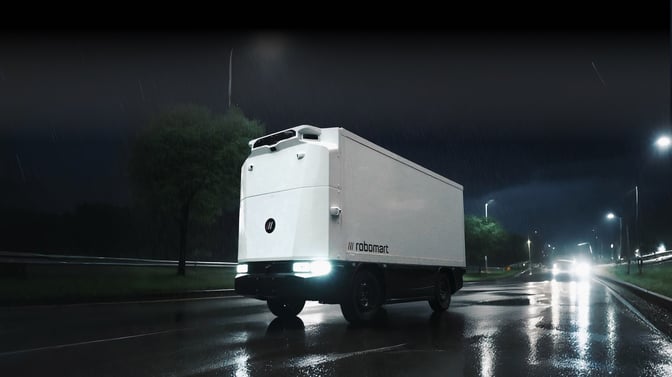
Robomart builds autonomous mobile stores that bring goods directly to consumers—no delivery driver, no checkout lines, and no last-mile fulfillment handoff. Its latest vehicle, the Robomart RM5, is a fully driverless, low-speed electric vehicle designed to operate on public roads, with ten secure lockers capable of carrying up to 500 pounds of goods across ambient, chilled, and heated compartments. Each vehicle is equipped with autonomous navigation, computer vision, and inventory-tracking sensors that enable customers to summon a Robomart via the app, unlock a locker curbside, and pick up their order in minutes. The platform supports batch orders and real-time routing, and is designed to deliver higher capacity and faster turnaround than sidewalk robots or drones.
The company operates under a hardware-as-a-service (HaaS) model. Robomart retains ownership of its autonomous vehicles and licenses them to retail partners on a subscription basis, bundling vehicle hardware, autonomy software, inventory tracking, branding, remote operations, and maintenance into a single service. Retailers pay a monthly fee and share in per-transaction revenue, allowing them to launch mobile storefronts or pilot new delivery formats without investing in real estate, delivery fleets, or human couriers. By using fully autonomous vehicles, Robomart positions on-demand delivery as economically viable at scale, citing cost reductions of up to 70% compared to human-based delivery models.