

Share
by Zachary Kimball on August 17, 2026
Hardware-as-a-service (HaaS) is gaining momentum across a variety of industries. Many of the early adopters of HaaS are in robotics, offering robots-as-a-service (RaaS) to decrease barriers to entry and improve overall value to customers. Others offer machine-as-a-service (MaaS), device-as-a-service (DaaS), or equipment-as-a-service (EaaS).
Some companies pitch outcomes more than assets, offering data-as-a-service or platform-as-a-service models. From network-as-a-service to facades cleaning; managed service providers (MSPs) to managed security service providers (MSSPs); and autonomous construction equipment to diagnostic sensors and 3D printers, these companies are on the cutting-edge of their fields.
This post is part of a series about modern hardware companies, their business models, and the future of HaaS. For more, see posts from early and late April, early and late May, early and late June, and early and late July.
Kinisi
- Founded: 2024
- Location: San Francisco, California (engineering office in Bristol, UK)
- Employees: ~25
- What they do: Wheeled humanoid robots for warehouse and industrial automation
- Customers: Enterprise manufacturers, logistics operators, and retailers
- Website: kinisi.com
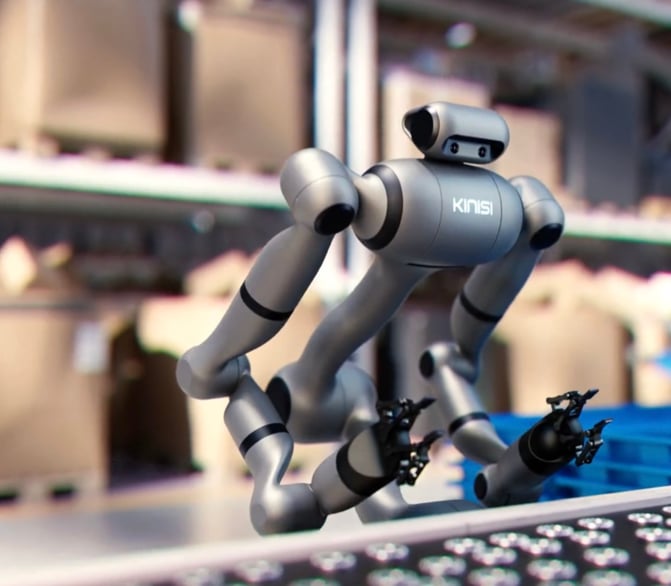
Kinisi Robotics builds a production-oriented humanoid robot platform designed to perform real warehouse and industrial tasks at scale. Its flagship robot, KR1, combines a self-balancing wheeled base with a humanoid upper body capable of material handling, pick-and-place, palletizing, packaging, and light assembly. The hardware is intentionally optimized for flat-floor environments, prioritizing speed, payload capacity, and durability over bipedal locomotion. A vertically integrated sensor and compute stack, including 3D vision, force-torque sensing, and onboard edge AI, enables the robot to perceive, grasp, and manipulate objects autonomously without relying on cloud connectivity.
Kinisi operates a robot-as-a-service (RaaS) business model built around subscription-based deployments rather than upfront equipment sales. Deployments include a one-time setup fee bundled with a monthly subscription covering hardware access, onboard AI software, continuous updates, maintenance, and support. This OpEx-oriented model lowers the barrier to adoption, supports pilot-first deployments, and allows customers to scale fleets incrementally as value is proven. Software is not sold as a standalone product; Kinisi's autonomous control, task-learning, and perception systems are embedded directly into the subscription, making recurring revenue inseparable from ongoing robot performance.
“Our focus is on robots that show up to work every day and actually move the needle for operators,” says Shannon Needham, Head of Business Operations at Kinisi. “By delivering KR1 as a subscription, we remove the friction of large capital purchases and give customers a practical way to deploy advanced robotics, whether that's a Fortune 500 manufacturer or a regional logistics provider. They can start with a single robot, prove the ROI, and scale from there.”
Crestron Electronics
- Founded date: 1971
- Location: Rockleigh, New Jersey
- Employees: ~2,280
- What they do: AV control and building automation platform
- Key customers: New York Giants, Sealed Air, The Camellias, Fox Valley Technical College, SAP Finland
- Website: crestron.com
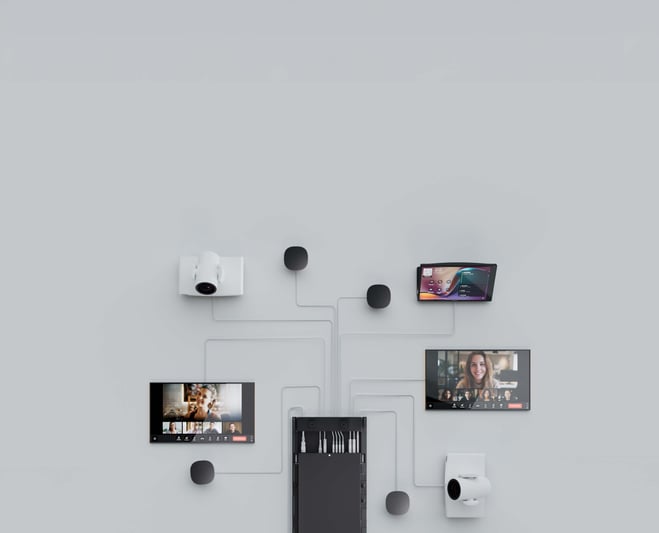
Crestron Electronics builds the equipment that controls everything happening inside a meeting room, lecture hall, hospital corridor, or smart home: AV signals, lighting, climate, conferencing systems, and the touch surfaces people use to operate it all. The DM NVX line distributes audio and 4K video over standard IP networks, letting a corporate campus route any source to any display without running dedicated AV cables to every room. The DM NAX platform handles audio for collaboration spaces. The 80 Series touch screens are the in-room control surfaces that people touch to dim lights, lower shades, join the Teams meeting, or switch the AV source, all from one place. Collab Compute is a dedicated computer that runs Microsoft Teams, Zoom, and Google Meet natively in the room. The XiO Cloud platform sits above the fleet for remote provisioning, monitoring, and policy management; Crestron Home OS is the residential equivalent for smart-home customers.
Crestron's commercial model is hardware-as-a-service at scale: customers buy the in-room hardware up front through a global integrator and dealer channel, then subscribe to XiO Cloud for fleet management. XiO Cloud has two tiers: a free tier that handles unlimited rooms and devices for basic provisioning and monitoring, and a Premium tier sold per device or by room-based pricing that adds third-party device management, historical reporting, ServiceNow integration, and remote touch-screen control. The Premium tier scales linearly with rooms, so a single deployment can span dozens of buildings while reporting through one dashboard.
Neocis
- Founded: 2009
- Location: Miami, Florida
- Employees: ~115
- What they do: Robotic systems for dental implant surgery
- Key Customers: Boston University Henry M. Goldman School of Dental Medicine, New York University College of Dentistry, West Virginia University School of Dentistry
- Website: neocis.com
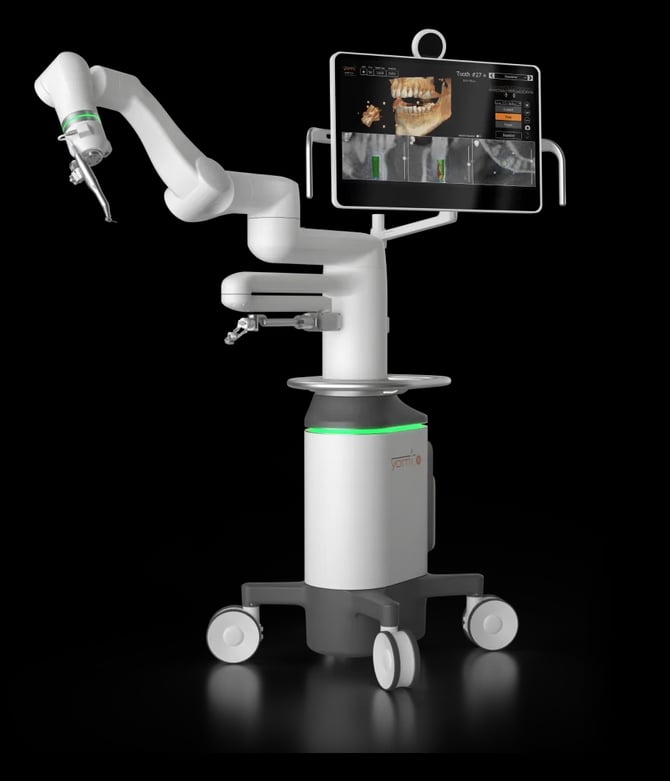
Neocis builds Yomi, a haptic-guided robotic system for dental implant surgery. The dentist plans the implant placement on a 3D scan of the patient's jaw, and during surgery the robotic arm physically guides the drill along the planned path, resisting motion that falls outside the plan and adjusting in real time if the patient moves. The original Yomi system handles the full range of single-implant and full-arch cases. Yomi S adds a single-operator workflow built around voice commands, a touchscreen, gesture controls, ambidextrous design, and a smaller operatory footprint. Both systems run on the YomiPlan software suite: YomiPlan Complete for full pre-operative digital planning from CT imaging, and YomiPlan Go for intra-operative planning when no pre-op CT is available. Yomi S adds YomiPlan AI, which auto-segments nerves and sinuses from CBCT scans so the planning workflow that used to require a dental assistant now collapses to one clinician.
The company's commercial model is hybrid: practices and dental schools purchase the Yomi system, and Neocis maintains a continuing software-and-services relationship across every installed unit. The recurring layer runs through the YomiPlan suite, and includes ongoing clinical education, customer-portal access, and a steady cadence of expansions that push new procedure types and drill compatibilities to every robot in the field. Software updates and new behaviors reach the installed base without a hardware swap, so the value of an early Yomi keeps compounding as the platform itself learns to do more procedures.
Aquabyte
- Founded date: 2017
- Location: San Francisco, California (global HQ: Bergen, Norway)
- Employees: ~100
- What they do: AI-powered underwater cameras for fish farming
- Key customers: Kaldvík, Arctic Fish, Mowi
- Website: aquabyte.ai
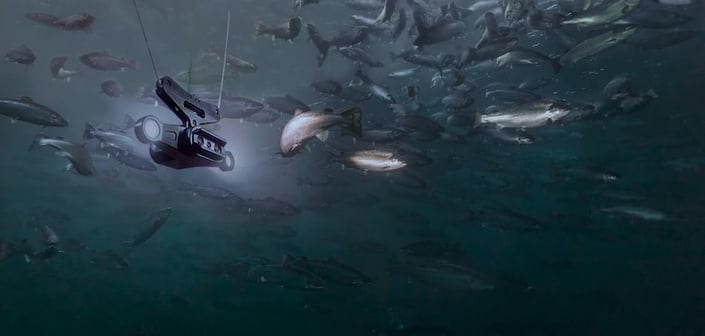
Aquabyte builds underwater cameras that watch farmed fish continuously and turn the captured images into operating decisions for the salmon farms that buy them. The Hammerhead is the newest camera in a lineup that also includes the Atlas stereo camera and the Hydra 360, a seven-lens model for full pen visibility. Hammerhead drops into a pen on a tether, lights the surrounding water with built-in LEDs, and captures over a million images per camera per day. Self-cleaning lenses, multiple sensors, a compact form factor, and low weight reduce the routine handling that aquaculture operators historically had to do for in-pen instrumentation. The captured imagery streams to the Aquabyte User Portal, where computer-vision models surface three primary categories of insight: biomass and growth estimation from individual-fish weight measurements; automatic sea-lice counting and outbreak forecasting; and appetite-driven feeding optimization that cuts feed waste.
Aquabyte sells the cameras into customer pens and runs the recurring relationship through the User Portal, where biomass, lice, and feeding insights live; without it, the cameras would deliver raw image data with no actionable interpretation. This is a hardware-as-a-service commercial structure: the cameras are the entry point, the data services on top are what the customer pays for over time, and the recurring economics scale with the number of pens instrumented across a customer's farm operations.
Robotics Plus
- Founded date: 2008
- Location: Tauranga, New Zealand
- Employees: ~110
- What they do: Autonomous robots for orchards, vineyards, packhouses, and ports
- Key customers: Treasury Wine Estates, ISO Limited
- Website: roboticsplus.co.nz
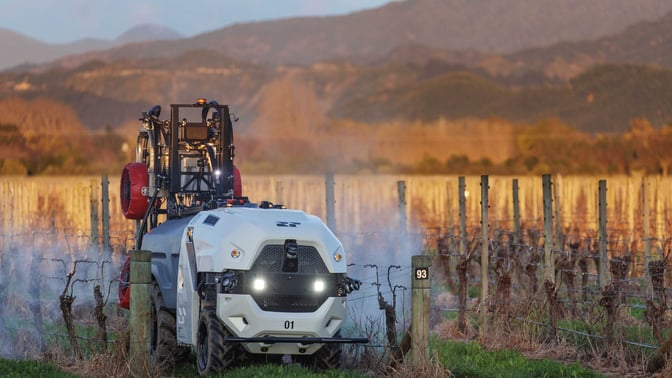
Robotics Plus builds autonomous machines that take over the most labor-intensive jobs in specialty agriculture and forestry: spraying and weeding orchard rows, packing fruit into trays, and measuring logs as they roll off a truck. The flagship is Prospr, a hybrid diesel-electric unmanned ground vehicle that drives itself between rows of grapes, apples, and other tree crops, applying spray, pulling weeds, or scouting canopy condition without an operator on board. The Q Series Sprayers (Q4, Q6, and Q8) are co-developed with Croplands and bolt to the Prospr modular tool rail, adjusting spray rates by canopy zone. In a packhouse, the Aporo Fruit Packer picks and places more than 100 fruit per minute into ready-to-deploy trays. At a port, the Log Scaler uses lidar, cameras, and neural networks to measure logs on trucks and trains in mobile or fixed configurations, processing up to 20 trucks per hour. Robotics Plus owns the autonomy stack and computer-vision models running across all three product families.
The commercial model is a hybrid of distributor-led hardware sales and continuing software-and-service ownership. Prospr is sold through agricultural distributors, so the upfront economics for a grower look more like buying a tractor than subscribing to a robot fleet. What keeps Robotics Plus in the operation is the autonomy layer: every Prospr depends on perception models, navigation behaviors, and tool-specific routines that Robotics Plus develops and updates centrally, so new spraying, mowing, or scouting routines reach the installed fleet without a hardware swap. The Log Scaler is the exception: it runs on a pay-per-use model, charging a per-ton royalty on every truckload scanned on top of the hardware sale.